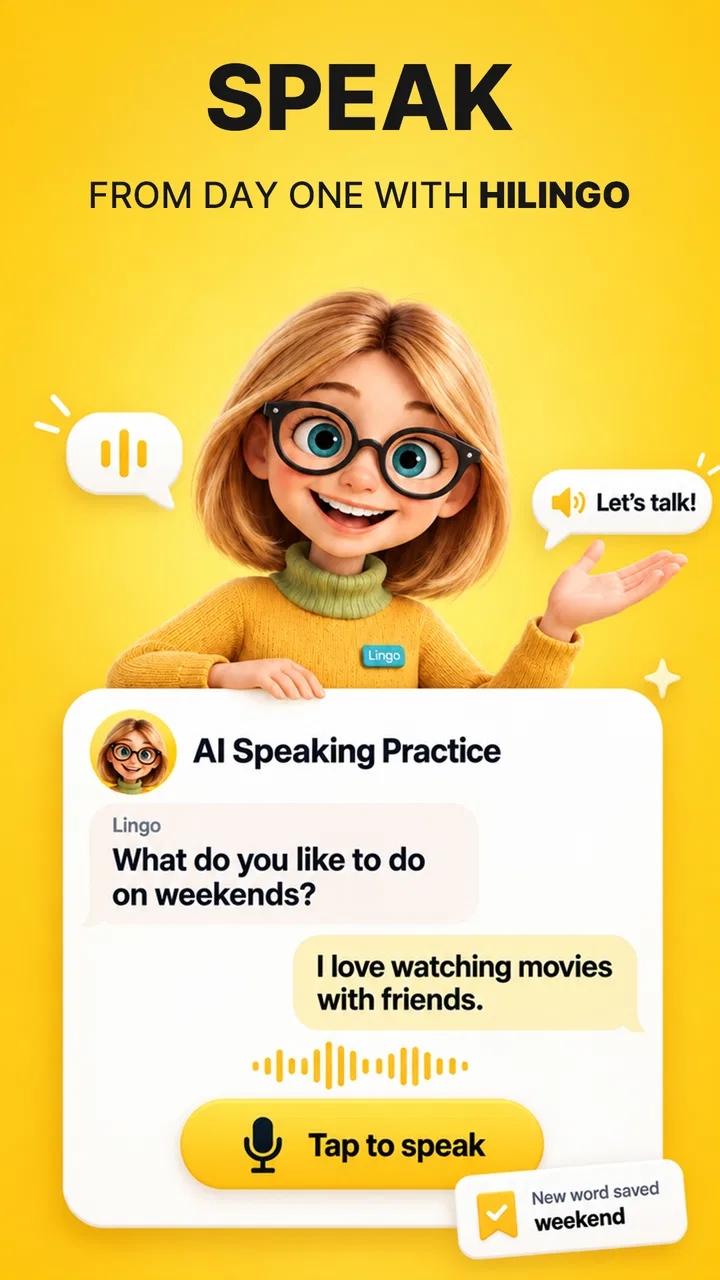
Hilingo: Learn & Speak English
- 4.7
- Rating
- 1.00M
- Installs
- Free
- Price

 Analysis by App-foxy
I spent time with Hilingo: Learn & Speak English as an education app, and my first impression was that it aims to make speaking practice feel less intimidating than a traditional language course. Its focus is clear: English learning, spoken practice, and interaction with AI rather than only memorizing words or completing written exercises. That makes it interesting for learners who understand more English than they can comfortably say out loud.
The app is developed by Pera Soft and is available free of charge, although it includes optional in-app purchases ranging from $4.99 to $49.99 per item. That distinction matters. You can approach it without paying at the start, but anyone considering long-term use should decide whether the free access already supports their routine or whether the paid options add enough value to justify the cost. I would not treat the presence of a free download as proof that every learning element is free.
Hilingo has an Everyone age rating, which makes it approachable for a broad audience. It runs on Android 7.0 or later, and the current version is 2.0.7. With over 100 thousand installs and a perfect 5.0 average from 167 ratings, it has attracted a positive early audience. Those figures are encouraging, but I still see them as a starting signal rather than a substitute for testing the learning experience yourself.
You May Also Like

 Blood Strike: 2.5 Anniversary
Blood Strike’s Loadouts Turn Every Drop Into a Tactical Gamble
A close look at Blood Strike’s custom loadouts: how fast access to signature weapons reshapes its battle royale rhythm, rewards preparation, and narrows the gap between fights.

 Pandora - Music & Podcasts
Pandora’s Music Is Easy to Start, but Harder to Recover
Pandora’s strength is its low-effort path from a seed to a station. Its weak spot is how much confidence it asks you to place in connection, setup, and quiet recovery.

 8 Ball Pool
 Is Built on Rivalries, Rematches, and Routine
A close look at the rivalries, rematches, shared routines, and unanswered safety questions that turn a quick pool match into a persistent mobile community.

 Samsung Music
’s Quiet Strength Is Playing What You Already Own
Its reach comes less from spectacle than from dependable access to a personal library. That simplicity is both the app’s strongest retention engine and its ceiling.

 AccuWeather: Weather Radar
AccuWeather Review: A Quick, Clear Forecast for Everyday Decisions
For everyday plans, the best forecast is the one you can understand quickly. AccuWeather makes rain timing, radar, and local conditions easy to act on, with a few trade-offs.

 Hill Climb Racing
Why Hill Climb Racing Still Turns Crashes Into One More Run
A tiny car, a bumpy hill and one more upgrade: Hill Climb Racing keeps resurfacing because its simple chaos makes every near-miss feel personal.
More From Our News Desk



How Hilingo Fits Into Real English Practice
I’d use this section to connect Hilingo’s speaking-first approach with the moments when English practice needs to be useful outside a lesson. A practical way to begin is to choose one upcoming conversation, rehearse several possible responses, and notice which parts still feel difficult; that gives each session a clear purpose without turning practice into memorization.
A speaking-first approach for learners who freeze in conversation
Many English apps are strongest at vocabulary recognition, spelling, or grammar drills. Those activities are useful, but they do not always prepare you for the moment when another person asks you a question and expects an answer immediately. Hilingo’s appeal is that it places speaking and practice at the center. In my view, that makes it more relevant to the learner who already knows basic phrases but struggles to produce them naturally.
I would use it as a low-pressure rehearsal space. Before a phone call, a trip, a class discussion, or a workplace conversation, practicing possible answers with an AI-based language app can help reduce the blank-mind feeling that often appears in real life. The goal is not to replace human conversation. The goal is to make the first real conversation feel less unfamiliar.
A practical routine would be short and consistent. I would open the app during a quiet part of the day, choose a speaking task that matches something I may need to say, answer aloud instead of silently reading, and then repeat the same idea in a slightly different way. That last step is important because memorizing one perfect sentence can leave you stuck when the conversation changes.
What the AI angle changes
AI can make practice more flexible than a fixed lesson sequence. A human tutor has limited availability, while an app can be opened whenever the learner has a few spare minutes. For someone who feels embarrassed about making mistakes in front of classmates, that privacy is a genuine advantage. I can try an answer, notice where I hesitate, and try again without worrying about holding up a group.
At the same time, I would keep expectations realistic. AI conversation practice is not identical to speaking with a patient teacher or a native speaker who understands the full context of a discussion. It may help with confidence and repetition, but learners still need exposure to different voices, accents, speeds, and real conversational habits. Hilingo works best as one part of a speaking routine, not as the entire English environment.
One useful way to get more from it is to bring your own situations into practice. Instead of treating every session as a general English exercise, I would prepare a small set of personal needs: introducing myself, explaining a problem, asking for clarification, describing my work, or making a simple request. This turns the app from a casual language tool into a rehearsal method connected to daily life.
Value when you use the free access carefully
The free starting point is valuable because it lowers the risk of trying the app. A learner does not have to commit money before discovering whether speaking to an AI feels comfortable, whether the practice style suits their level, or whether the app fits their phone and routine. That is especially useful for beginners who are comparing several English-learning tools.
Still, free access and free learning are not always the same thing. Since Hilingo offers purchases from $4.99 to $49.99 per item, I would examine what is available before building a study plan around a feature that may require payment. The sensible approach is to use the free portion first, decide whether it helps you return regularly, and only then consider a purchase. Paying immediately because the app has a strong rating would be a poor reason on its own.
The pricing range also suggests that paid value may vary considerably depending on the item. A lower-cost purchase can be easier to justify for a learner who wants to test an expanded experience, while the higher end deserves more careful thought. I would compare the purchase with the amount of practice I realistically expect to complete. An expensive learning option is not good value if it becomes another app I open twice and forget.
Small habits that make the app more useful
The most effective use is probably not a long session once a week. I would favor repeated, focused practice. A short speaking session on a familiar topic can reveal pronunciation hesitation, missing vocabulary, and sentence patterns that need work. Writing down those trouble spots after practice gives the next session a purpose instead of starting from zero.
I would also avoid answering with the shortest possible phrase every time. If a prompt invites a simple response, I would add a reason, an example, or a follow-up detail. For instance, instead of saying only that I like a job, I might explain what I do and why I enjoy it. This creates more speaking practice and prepares me for the natural follow-up questions that occur in human conversations.
Another useful trade-off is accuracy versus fluency. Beginners often stop after every uncertain word, which can make speech painfully slow. During one pass, I would focus on finishing the thought without stopping. During a second pass, I would correct grammar or replace awkward wording. Separating those goals makes practice less frustrating and better reflects the difference between communicating an idea and polishing it.
Where it may fall short
My main caution is that the app’s central promise can be interpreted too broadly. Practicing with AI may improve willingness to speak, but it does not automatically create strong listening skills, natural pronunciation, broad vocabulary, or reliable grammar in every situation. A learner preparing for an exam, professional interview, or advanced academic work will probably need additional resources with structured progression and detailed correction.
I would also hesitate to recommend it as the only tool for someone who needs immediate human feedback. Some mistakes are difficult to notice without a teacher explaining why a phrase sounds unnatural or how context changes meaning. Hilingo can support repetition, but it should not be expected to provide every kind of instruction a language school or tutor offers.
The purchase model is another point to consider. The app is free to begin, but optional items can reach $49.99. That makes it important to inspect the payment choices calmly rather than assuming the free installation represents the full experience. For families, students, or anyone working with a strict budget, the decision should be based on the actual free practice available and the specific benefit of any paid item.
There is also a motivational limitation that applies especially to speaking apps: convenience can become passivity. An AI partner is easy to access, but easy access does not guarantee regular practice. If you prefer a clear textbook path, scheduled lessons, visible milestones, or teacher accountability, a conventional course may keep you moving more effectively. Hilingo’s flexibility is a strength only when the learner supplies some structure.
Who is most likely to benefit
I see the strongest fit for beginners and intermediate learners who want to speak more often but lack a comfortable practice partner. It can also suit people who understand English videos or written messages reasonably well yet hesitate when they must answer aloud. The private, repeatable nature of AI practice is particularly useful for building the courage to make mistakes.
It may be helpful for travelers who want to rehearse practical conversations, workers who need to introduce their role or explain routine tasks, and students who want extra speaking time outside class. In each case, the benefit comes from turning a vague goal such as “improve my English” into specific spoken situations that can be practiced repeatedly.
A realistic example would be someone preparing for a first day in an English-speaking workplace. I would use Hilingo to rehearse a self-introduction, explain what I have worked on, ask a colleague to repeat something, and describe a problem with a task. I would not try to memorize a script. I would practice several versions of each idea so I could respond naturally if the conversation moved in an unexpected direction.
The app is less suitable for a learner who already speaks confidently and wants advanced debate, highly specialized terminology, or nuanced academic editing. It is also not the best match for someone who learns better through silent reading and written exercises. Speaking practice can be uncomfortable, and an AI format will not appeal to everyone. If you dislike talking to a phone or prefer direct instruction from a teacher, another option may feel more productive.
How it compares with familiar alternatives
Compared with flashcard apps, Hilingo appears more useful for turning knowledge into spoken output. Flashcards are excellent for recalling vocabulary, but they rarely recreate the pressure of forming a complete answer. I would use flashcards to build the raw material and Hilingo to practice assembling that material into speech.
Compared with grammar-focused apps, its attraction is less about explaining rules and more about using language actively. Grammar tools can show why a sentence is formed a certain way, while speaking practice helps reveal whether I can produce that sentence without stopping. Neither approach replaces the other. A learner who repeatedly makes the same grammar mistake may need a dedicated explanation before returning to conversation practice.
Compared with a human tutor, Hilingo is more convenient and likely easier to use for frequent low-stakes repetition. A tutor remains stronger for personalized correction, cultural context, and adapting lessons to subtle weaknesses. The choice depends on the problem. If I mainly need confidence and more chances to speak, the app may be enough to make progress. If I need precise diagnosis and accountability, human guidance is the better investment.
Compared with free conversation exchanges, the app offers a more controlled environment. A language partner can provide authentic unpredictability and cultural insight, but arranging schedules and finding a comfortable match can take effort. Hilingo is better for immediate practice; a real partner is better for testing whether that practice survives outside the app.
Device, audience, and practical expectations
Hilingo supports Android devices running version 7.0 or later, so compatibility should be comfortable for many existing Android users. Its Everyone rating also makes it broadly approachable, although parents should still decide whether an AI conversation tool fits the learning habits and supervision expectations of their household.
The current version, 2.0.7, indicates that the app is being presented in a maintained version rather than an early installation package. I would still judge it by everyday usefulness: how quickly I can begin practice, whether the prompts feel relevant, whether I understand the feedback, and whether I want to return tomorrow. Version information is helpful for compatibility, but it does not tell me whether the teaching style matches my needs.
The perfect 5.0 average from 167 ratings and the 100K-plus install milestone make Hilingo look promising, particularly for a relatively focused education app. I would interpret that response with some care because a rating average reflects the people who chose to rate it, not every learner who tried it. The positive reception is worth noting, but personal fit matters more than the headline number.
My buying decision
I would start with the free version and use it long enough to establish a routine before considering an in-app purchase. The free entry point makes experimentation sensible, while the purchase range means the paid decision should be deliberate. I would pay only if the available practice already feels useful and the specific item clearly addresses a weakness I have identified.
For a learner who needs confidence speaking English, wants private practice, and is willing to create a simple routine, Hilingo offers a convincing reason to try it. Its strongest value is not that it magically teaches every part of English. It is that it can make speaking practice easier to begin and easier to repeat.
I would skip it as a primary solution if my goal were advanced exam preparation, detailed teacher correction, or a complete course with a tightly prescribed curriculum. In those cases, a tutor, structured program, or combination of specialized tools would be more appropriate. I would also skip a paid purchase if I could not explain exactly how it would improve my study routine.
Overall, I see Hilingo: Learn & Speak English as a useful, approachable speaking companion rather than a complete replacement for language learning. Pera Soft has positioned it in a practical space: helping learners move from knowing English to actually attempting it. Because it is free to start, the risk of testing that approach is low. My recommendation is simple: try the free access, speak aloud consistently, track the situations that remain difficult, and spend money only when a paid option solves a clearly identified need.
FAQs for Hilingo: Learn & Speak English
01What is Hilingo: Learn & Speak English?
Hilingo: Learn & Speak English is a mobile language-learning app designed to help users improve their English through structured lessons, vocabulary practice, listening activities, and speaking exercises. Its format is aimed at learners who want short, accessible study sessions rather than a traditional classroom course. The app may be useful for beginners and intermediate students, although the available content and difficulty can vary depending on the selected learning path.
02Is Hilingo suitable for complete beginners?
Yes, Hilingo can be a suitable starting point for people who are new to English, especially those who need help with everyday vocabulary, basic phrases, pronunciation, and simple sentence construction. Lessons are generally presented in manageable steps, making them less intimidating than studying from a large textbook. However, users should still practice regularly outside the app because an application alone cannot replace real conversations, writing practice, or detailed teacher feedback.
03Does Hilingo help with English speaking and pronunciation?
Speaking practice is one of the main reasons to consider Hilingo. The app includes activities intended to encourage users to repeat words and phrases, listen to examples, and become more comfortable producing English aloud. This can help build confidence and improve familiarity with common expressions. Nevertheless, automated pronunciation feedback should be treated as guidance rather than a perfect evaluation, since it may not recognize every accent, background noise, or natural variation in speech.
04Is Hilingo: Learn & Speak English free to use?
Hilingo may offer free access to some lessons or introductory features, while additional courses, exercises, or learning tools can require a subscription or in-app purchase. The exact pricing, trial conditions, and available content may differ by platform, region, or promotion, so users should check the app’s current store listing before downloading. If a free trial is offered, review its renewal terms carefully to avoid unexpected charges.
05Does Hilingo require an internet connection?
An internet connection may be needed for downloading the application, creating or synchronizing an account, loading lessons, processing speaking activities, and receiving updates. Some learning materials might be available offline after being downloaded, but offline support should not be assumed for every feature. Before relying on Hilingo while traveling or without mobile data, test the lessons you need and check whether progress tracking and pronunciation exercises continue to work offline.
Pros
- Short lessons make it easy to practice during spare moments.
- Speaking exercises encourage active use instead of passive memorization.
- Progress tracking helps maintain motivation over time.
- Useful vocabulary is introduced through practical everyday topics.
- The interface is simple enough for beginners to navigate quickly.
Cons
- Some advanced grammar and vocabulary topics may feel limited.
- Speech recognition can occasionally misunderstand correct pronunciation.
- The free version may restrict access to several lessons or features.
- Repetition can make certain exercises feel predictable after extended use.
- A stable internet connection may be needed for some learning activities.

Hilingo: Learn & Speak English
Gallery